
Football drills for toddlers are short, playful games that help young children build coordination, balance and early ball skills. At Socatots, these are called games rather than drills, because toddlers learn best through play, repetition and fun. The games are matched to your child’s age and development stage, so a crawling baby and a busy three-year-old are doing very different activities, each suited exactly to where they are.
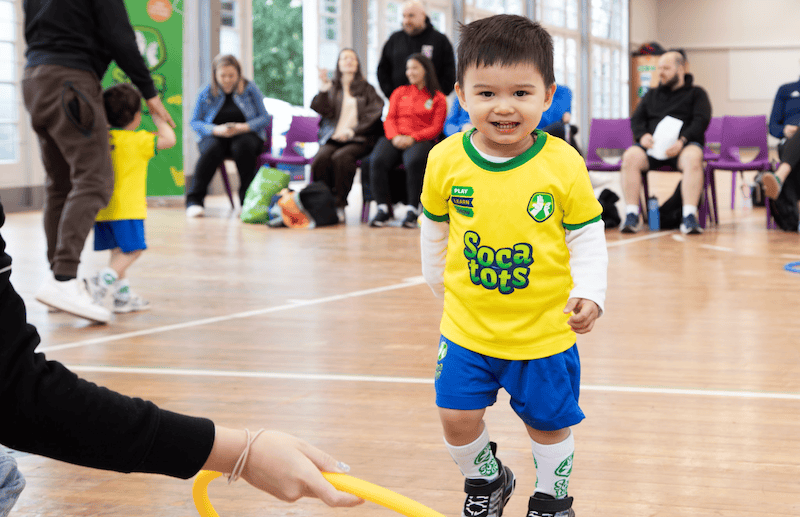
This guide explains what these activities really involve, why a game-based approach works so well at this age, how the activities change as your child grows, and how you can support their progress at home.
Explore our toddlers football classes
What are football drills for toddlers?
They are simple, repeatable activities that teach the foundations of movement and ball skills through play. In practice, and at Socatots in particular, they are better described as games, because a toddler will happily participate in an activity long before they would sit still for anything resembling a formal drill.
The word “drill” tends to bring to mind lines, whistles and repetition for its own sake. For toddlers, none of that applies. Every activity is designed to feel like play, with the skill-building tucked quietly underneath. That is a deliberate choice, because young children are far more motivated by fun than by instruction, so the games do the teaching while your child simply enjoys themselves.
At Socatots, our games all involve skittle, domes, cones, bean bags and smaller Size 1 football, as recommended for children under 5 years old, and we do games that involve knocking down the skittles with the ball or bean bag. Each week, the games will focus on different parts of the foot, helping your child to steadily develop their ball skills.
Why do toddlers learn football skills better through games?
Toddlers learn best through games because play matches how their brains and bodies develop at this age. Short attention spans, boundless energy and a love of repetition all make playful, game-based activities far more effective than structured drills.
“They [toddlers] might spend lots of time doing a certain activity, like moving all the sand out of a sandpit or putting little passengers into a toy bus over and over again. By repeating actions, they start to understand how objects and ideas connect, and through a concept called cause and effect, they learn that their actions can have interesting results. Play doesn’t just keep them busy, it’s essential for brain development.”
– How toddlers learn through play, Video Transcript, BBC
Young children are naturally driven to explore and move. A game gives that drive a gentle shape, turning restless energy into coordination, balance and control without the child even noticing they are practising. Because games are fun, children want to do them again, and that repetition is exactly how young brains and bodies lay down new physical skills.
There is a social and emotional layer too. Playing games with a parent, a coach and other children builds confidence, communication and the early experience of taking turns, all of which matter just as much as the football skills themselves. A child who associates being active with fun, kindness and making friends is far more likely to carry a love of movement into later childhood and adult life.
How do football drills for toddlers change with age?
The games change significantly with age, because a six-month-old and a three-year-old have very different abilities. The games begin with the most basic foundations of movement and gradually build toward genuine ball control as your child grows.
At Socatots, the activities are grouped into stages, each designed around what a child of that age is ready for. The table below outlines those stages:
| Stage: | Age guide: | What the games focus on: |
| Phase 1 | 6 months to 1 year old | Fundamental movement, focusing on one part of the foot, encouraging children to crawl, building coordination, developing balance, exploring equipment and new objects |
| Phase 2 | 1 to 3 years old | Developing coordination, balance and dexterity, colours and numeracy, developing basic ball skills, putting things together and speeding it up |
| Phase 3 | 3 to 5 years old | Developing ball control ready for move to Brazilian Soccer Schools, gaining confidence in their balance, improving coordination, working on fully understanding instructions, juggling introduced, begin working in pairs and groups |
What skills do football drills for toddlers build?
Football drills/games build a surprisingly wide range of skills, and they layer on top of one another as your child grows. The physical skills tend to get the attention, but the cognitive and social gains are just as valuable and often last a lifetime. The table below shows the skills that can be acquired through football:
| Skill area: | What playful football games help develop: |
| Physical | Coordination, balance, leg strength, and early ball control such as dribbling, stopping and kicking |
| Cognitive | Concentration, following simple instructions, counting, and understanding sequences and turn-taking |
| Social and emotional | Confidence, communication, sharing, and a genuine enjoyment of being active |
What makes the games so effective is the way each stage builds on the last. The coordination a baby develops in their first year becomes the balance a one-year-old needs, which in turn becomes the ball control a three-year-old starts to master. Nothing is rushed, and no skill is introduced before a child is ready for it, which is why a game-based, age-matched approach works so much better than a one-size-fits-all set of drills.
How can you get the most from football drills for toddlers at home?
The best way to reinforce these games at home is to keep things playful, short and pressure-free. You are not trying to run a training session, simply giving your child a few more chances to enjoy moving and using a ball.
A few simple principles help:
- Use a soft, lightweight ball that is easy for little feet to control.
- Keep each go to just a few minutes, because young children learn far more from little and often play than from anything longer.
- Follow your child’s lead, celebrate every small effort, and stop while they are still enjoying it so they are keen to have another go next time.
- Join in, because your enthusiasm is what makes the whole thing fun.
There is no right or wrong way to play at this age, so relax and let your child explore the ball in their own way.
What does a Socatots session look like?
A Socatots session is built around fun first, with the skill-building woven through games that are matched to your child’s age. Sessions are led by an FDS UK qualified coach, which may be your local franchisee or a coach they have trained through FDS UK Leadership, and you take an active role alongside your child throughout.
The length of the session is dependent on your child’s age and which Phase they are in but our sessions range from 30 minutes for the youngest children and 45 minutes for the older children. We advise that your toddlers come to a session once a week so it becomes part of their routine. Routine is so important for children and it will help them to get used to and look forward to the sessions.
Because our sessions are game-based, they suit even the youngest members and give your child a familiar, supportive environment to grow in week after week. The predictable rhythm helps toddlers feel secure enough to try new things, which is when the best learning happens.
Frequently asked questions about football drills for toddlers
At what age can my child start football drills for toddlers?
At Socatots, children can start from as young as six months old. The games are matched to your child’s age and development stage, so there is always something suitable no matter how young they are.
Are football drills too advanced for toddlers?
Not at all. At this age they are really games rather than formal drills, designed entirely around what a toddler can do and enjoy. Nothing is introduced before your child is ready for it.
Do I need to know anything about football to help my child?
No. The coach leads every activity, and at home you are simply playing and cheering your child on, so no football knowledge is needed.
Who runs Socatots football sessions?
Every session is led by an FDS UK qualified coach, so your child is always in experienced, properly trained hands.
Can we practise the games at home?
Yes. Keeping it short and playful, you can repeat simple movements and ball games between classes to help your child’s skills develop. You can buy the right sized ball and some other equipment from our online shop but, during classes, this will all be provided.
Giving your toddler a great start through football games
Football drills for toddlers work best when they never feel like drills at all. By turning skill-building into games that are matched to your child’s age, Socatots helps even the youngest children develop coordination, balance and ball control while having fun, building confidence and learning to enjoy being active.
From their very first session, your child is doing exactly the right activities for their stage, supported by you and guided by a qualified coach. It is a foundation that sets them up not just for football, but for a lifelong love of movement.