
Our toddler football classes in Selby will help your toddler with the development of their cognitive skills. Here, we will dive into how they will help.
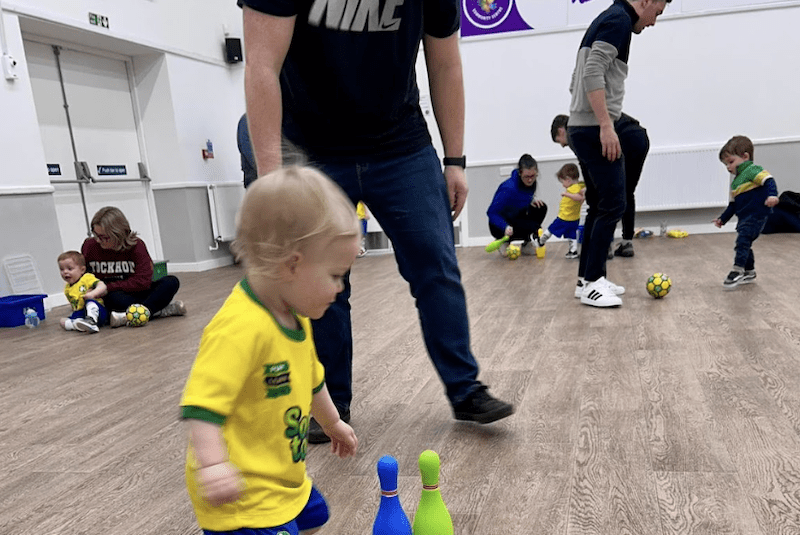
Choosing the right extracurricular activity for your toddler is a decision often driven by a desire to help their overall growth whilst being fun and engaging. While the physical benefits of movement are immediately apparent, the profound impact that structured, play-based activities like toddler football classes can have on cognitive development is often underestimated. Our classes are specifically designed to be fun whilst also helping crucial skills to develop such as cognitive skills.
Cognitive development encompasses a wide range of mental abilities, including problem-solving, memory, attention, language, and the ability to process sensory information. During the toddler years, the brain is undergoing a period of rapid development, forming connections at an amazing rate. Our classes will help this and, within this article, we will let you know how.
Enhancing Attention And Concentration Through Play
One of the most immediate cognitive benefits observed in our football classes is the improvement of your toddler’s attention span and concentration. For a toddler, sustained attention can be fleeting. The structure of our classes is designed to keep young minds engaged. Activities are short, varied, and inherently fun, utilising colourful equipment and engaging coaches.
Problem-Solving And Decision-Making
Football, even at toddler level, is a continuous sequence of problems to solve. A toddler with a ball must constantly assess their environment and ask themselves questions:
What has the coach asked me to do? Which direction should I push the ball to avoid hitting another child?
These seemingly simple movements are, for a developing brain, complex puzzles. Our classes encourage what is known as ‘executive function’. Executive function is the set of mental skills that includes working memory, flexible thinking, and self-control.
When a coach sets up a simple obstacle course, such as dribbling around skittles, your toddler must engage in planning. They must hold the goal in their working memory – in this example: get the ball around the skittles, sequence the necessary steps – push the ball past the first skittle and so on – and adapt if the ball goes off course. This will all aid their cognitive development.
Language Development And Communication
While the physical movement is central, our classes are a language-rich environment that significantly boosts your toddler’s language and communication development. Our coaches use clear, concise language, linking actions directly to verbal commands. This reinforces vocabulary related to movement, such as run, stop, jump, kick, direction – left, right, forward backward etc. and spatial concepts, like over, under, next to, behind. You, the parent, are also involved throughout our classes so you will be there to help in any areas they don’t fully understand.
Beyond understanding instructions, the social setting of the class encourages early communication skills. Toddlers learn to interact with the coach and their peers, often using gestures or simple words to express needs or excitement. The shared goal of the activities promotes cooperation, which helps with teamwork and social communication. Listening skills are honed as the children must pay attention to the coach’s voice, often amidst the noise of a bustling class. This active listening is a vital cognitive skill that underpins later learning and helps them throughout their life.
Working, Short-Term And Long-Term Memory
Your toddler’s memory is constantly being stimulated when they attend our classes.
Working memory is the ability to hold and manipulate information over a short period and it is essential for multi-step instructions. In our classes it will be things like – pick up the ball, run to the cone, and sit down. By starting with one-step commands and gradually moving to three- or four-step sequences, our classes will help your toddler’s working memory.
Short-term memory is engaged when a toddler is asked to recall the rules of a game they learned minutes earlier or to remember which colour skittle they are supposed to aim for.
Long-term memory is built as the child consistently recalls and executes fundamental techniques, such as how to stop the ball with the sole of their foot, from week to week. The use of repetitive actions within a fun, engaging class will ensure that these skills are successfully encoded into their long-term memory.
The Role Of Emotional Regulation In Cognitive Growth
It is impossible to separate cognitive development from emotional development. A key component of cognitive development is emotional regulation and self-control. In our classes, your toddler will encounter situations that will create strong emotions. They will feel frustration when they find something challenging, excitement when they succeed, and the need for patience while waiting their turn.
Our classes provide a safe, supportive environment where your toddler can practice managing these feelings.
Ready For Toddler Football Classes In Selby?
Our toddler football classes in Selby will help your child’s cognitive development. By continually challenging your toddler in areas of attention, problem-solving, language and memory, our class will help your child with their cognitive development, ensuring that their young minds are prepared not just for the pitch, but for their life as a whole.